 Powered by Bioz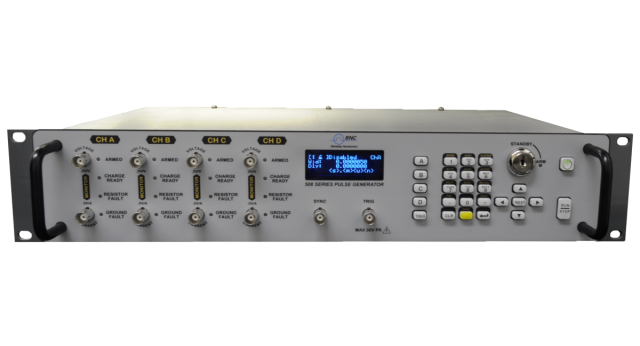
1Overview
The Model 508 is a precision current pulse generator built for critical initiator testing. Its defining strength is fast current drive: it delivers highly repeatable current pulses from 0.10 to 6 A per channel with sharp, well-controlled edges, then measures the result. The instrument is designed for airbag deployment, pyrotechnic initiator testing, igniter triggering, and ballistics work in automotive safety, aerospace, defense, and research labs.
What separates the Model 508 from a plain fireset is the measurement and safety layer wrapped around the output. Built-in current sensing and 4-wire resistance measurement let the operator characterize each device before and after firing. A removable arming key switch and a remote interlock mean the unit fires only when every safety criterion is met. Statistical firing modes such as Bruceton and Neyer support sensitivity testing across a population of devices.
The 508 ships in a 19-inch 2U rackmount form factor with 2 or 4 channels, front and rear trigger and sync, and RS232, USB, and optional Ethernet control.
2Key Features
- Fast current drive to 6 A. 0.10 to 6 A per channel with high slew rates and sub-microsecond resistive rise times.
- 2 or 4 independent channels. Each channel sets its own pulse and delay.
- Low jitter, fine resolution. 10 ns RMS jitter, 100 ns timing resolution, 20 ns accuracy.
- Integrated 4-wire resistance measurement. Pre-test and post-test bridge-wire characterization.
- Current and voltage monitor outputs. 0.5 V/A and 0.2 V/V isolated monitors for scope capture.
- Multiple firing modes. All-fire, no-fire, resistance measurement, DC current, capacitor discharge, Bruceton, Neyer, and high current.
- Advanced safety. Remote interlock plus removable arming key switch; fires only when all criteria are met.
- Flexible connectivity. RS232, USB serial bridge, optional Ethernet; front and rear sync.
3Channels & Timing Architecture

The Model 508 carries 2 or 4 output channels in a 19-inch 2U chassis. Each channel generates current pulses independently, triggered from the internal rate generator or from front or rear external trigger inputs. The internal rate generator spans 0.01 Hz to 40 kHz with 100 ns resolution, 20 ns accuracy, and 10 ns RMS jitter, and supports single-pulse and burst output of 2 to 250 pulses.
Speed is the point of the architecture. Into a resistive load, the rising edge reaches 6.3 A/microsecond at 6 A, and resistive rise time is about 550 ns. Into an inductive load with 50 feet of cable, the rising edge is 2 A/microsecond at 6 A with a 4 microsecond rise time. Pulse widths range from 5 microseconds to 100 seconds, with the upper limit set by amplitude: 1 A sustains up to 100 seconds, while 6 A is limited to 300 milliseconds. Delay spans 0 to 30 seconds at 100 ns resolution.
Output amplitude is programmable from 0.10 to 6 A at 2 mA resolution, +/- 0.5% to 2% accuracy, into a 19 to 22 V compliance. Isolated voltage and current monitor outputs feed an oscilloscope at 0.2 V/V and 0.5 V/A across a 100 kHz to 1000 kHz bandwidth.
4Specifications
| Parameter | Specification |
|---|---|
| Configurations | 508-2C (2 output channels); 508-4C (4 output channels); input module front and rear trigger |
| Current output (amplitude) | 0.10 to 6 A; 2 mA resolution; +/- 0.5% to 2% accuracy |
| Compliance voltage level | 19 to 22 Volts |
| Rise time (resistive, 1 ohm, 2 in cable, 6 A) | 550 ns (varies with load) |
| Rise time (inductive, 1 ohm, 50 ft cable, 6 A) | 4 µs (varies with load) |
| Slew rate, rising edge (inductive, varies with load) | 2 A/µs @ 6 A; 1 A/µs @ 3 A; 0.30 A/µs @ 1 A (1 ohm and 50 ft cable) |
| Slew rate, falling edge (inductive, varies with load) | -1.60 A/µs @ 6 A; -0.90 A/µs @ 3 A; -0.30 A/µs @ 1 A (1 ohm and 50 ft cable) |
| Slew rate, rising edge (resistive, varies with load) | 6.3 A/µs @ 6 A; 9.5 A/µs @ 3 A; 2.2 A/µs @ 1 A (1 ohm and 2 in cable) |
| Slew rate, falling edge (resistive, varies with load) | -5.2 A/µs @ 6 A; -4.0 A/µs @ 3 A; -1.3 A/µs @ 1 A (1 ohm and 2 in cable) |
| Pulse width range | 5 µs to 100 s*; ±0.1% error; 100 ns resolution (* maximum pulse width is limited by current amplitude: 1 A can go up to 100 s, 6 A is limited to 300 ms) |
| Delay range | 0 to 30 s; ±0.1% error |
| Internal rate generator | 0.01 Hz to 40 kHz; 100 ns resolution; 20 ns accuracy; 10 ns RMS jitter; output modes single pulse, burst (2 to 250 pulses); control modes internal rate generator, external trigger |
| External trigger inputs | Generate individual pulses (single shot or burst); front or rear selectable; rate Min = 5 X longest pulse width, Max = 200 seconds; 300 ns insertion delay; 10 ns jitter; 1 kohm impedance; rising or falling slope |
| Trigger filter | Filters out unwanted “glitch” or “runt” pulses; range 0.02 µs to 1 ms; 0.02 µs resolution |
| Trigger level | 2 to 15 V; 100 mV level threshold |
| Current monitor (isolated) | 0.5 V/A; <4% error; bandwidth Min = 100 kHz, Max = 1000 kHz |
| Voltage monitor (isolated) | 0.2 V/V; <4% error; bandwidth Min = 100 kHz, Max = 1000 kHz |
| Resistance measurement | 0.1 to 150 ohm; 0.01 ohm resolution; <4% error (0.5 to 15 ohm); <10% error (16 to 150 ohm); 100 mA max measurement current |
| Sync outputs | Front and rear; T0, channels A through D |
| Safety | Remote interlock (shorting interlock); arming key switch (removable keyswitch); internal error checking (checks control circuit for errors) |
| Standard communications | USB (serial bridge); RS232 (115200, 57600, 38400, 19200, 9600, 4800 baud) |
| Size | 9 in, 2U x 10 in, 2U rackmount |
| Electrical | 100-240 V, 50-60 Hz |
| Weight | Consult factory (verify) |
5Triggering & I/O
The Model 508 triggers from its internal rate generator or from selectable front or rear external trigger inputs. External triggers accept a 2 to 15 V level on a 1 kohm input with rising or falling slope selection and a 100 mV level threshold. The external trigger rate runs from a minimum of 5 times the longest pulse width to a maximum of 200 seconds. A trigger filter rejects unwanted glitch and runt pulses across a 0.02 microsecond to 1 ms range, and insertion delay is 300 ns with 10 ns jitter. The unit fires single pulses or bursts of 2 to 250 pulses.
Front and rear sync outputs provide T0 and per-channel A through D references. Isolated current and voltage monitor outputs, at 0.5 V/A and 0.2 V/V, feed an oscilloscope so the operator can capture the delivered pulse directly. Control runs over a USB serial bridge or RS232 at baud rates from 4800 to 115200, with optional Ethernet.
6Options & Configurations
The Model 508 is ordered as the 508-2C with 2 output channels or the 508-4C with 4 output channels. The published option is Ethernet (E), which adds an Ethernet interface on top of the standard USB serial bridge and RS232 interfaces.
- 508-2C: 2 output channels
- 508-4C: 4 output channels
- E: Ethernet (optional)
7Applications
- Airbag deployment testing, squib detonation
- Pyrotechnic initiator and detonator testing
- Igniter triggering
- Ballistics work
- Bridge-wire resistance characterization, pre-test and post-test
- Statistical sensitivity testing (Bruceton, Neyer)
- General precision current pulse generation
8Ordering
To configure a Model 508, specify the channel count (508-2C or 508-4C) and whether the Ethernet option is required. For pricing and lead time, contact Berkeley Nucleonics.
| Model | Description |
|---|---|
| 508-2C | Current Pulse Generator, two independent 6 A channels, 2U rackmount |
| 508-4C | Current Pulse Generator, four independent 6 A channels, 2U rackmount |
| E | Ethernet option; adds Ethernet to the standard USB and RS232 interfaces |
Berkeley Nucleonics Corporation · info@berkeleynucleonics.com · 800-234-7858
Cited in peer-reviewed research
Independent publications citing this instrument, indexed by Bioz. Citation counts and Bioz Stars ratings are shown live and update as new papers are indexed.