 Powered by Bioz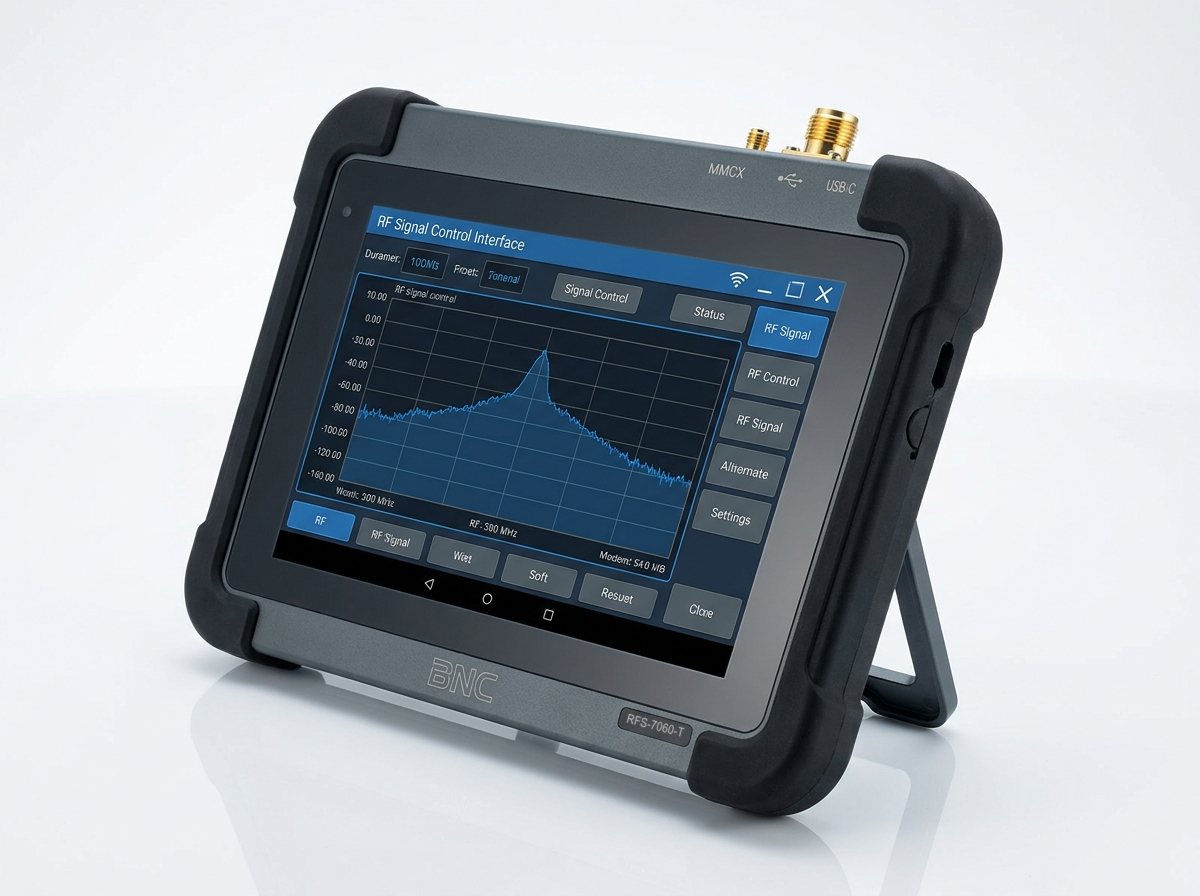
1Overview
The RFS-7060-T delivers instrument-class RF performance in a handheld chassis. Across 9 kHz to 6 GHz it holds a wide output-power range, low harmonics, low phase noise, and strong spurious suppression: the signal quality a bench source is judged on, now carried into the field. A 16-bit DAC feeds a clean baseband path, high-speed internal memory backs up to 100 MHz of arbitrary playback and 50 MHz of continuous real-time IQ streaming, and an FPGA interpolator trims the sample rate in fine steps so the waveform lands exactly where you need it.
Operation is direct. A 10.1-inch multi-touch display and a task-organized interface put every mode a tap away, and at 1.4 kg the instrument moves easily between the lab bench and the antenna range. Signal generation is comprehensive out of the box: single tone, multitone, frequency and power sweeps, digital ramp sweep, pulse modulation, and Gaussian noise, plus analog AM, FM, and PM and full IQ playback and streaming. No options are required to start working.
2Key features
RF performance
- 9 kHz to 6 GHz continuous coverage
- -124 dBc/Hz phase noise at 1 GHz, 10 kHz offset
- Output power up to +14 dBm (+25 dBm optional)
- Minimum output ≤ -100 dBm across the full range
- Harmonics ≤ -50 dBc (0 dBm, typical)
Signal generation
- 100 MHz playback / 50 MHz real-time modulation bandwidth
- 16-bit DAC for high-fidelity baseband
- 128 MB (32 M-sample) waveform memory
- FPGA high-factor interpolator; fine sample-rate steps
- Fine reference-frequency adjustment
Platform & field use
- 10.1-inch multi-touch display, intuitive interface
- 1.4 kg handheld; 2.5 h battery, runs from a power bank
- Built-in GNSS for timing, positioning, and frequency calibration
- LAN remote control
- USB PD (65 W) powering
3Connections
Every port sits on the top edge of the instrument, grouped for one-handed field use. Hover or tap a marker to identify each connector.
Top-edge I/O — hover a marker to identify
RF OUT 50 Ω · 10 VDC MAX · AUXIO: REF / TRIG / GNSS
The reference clock port carries the 10 MHz external reference input and the 100 MHz reference output. Trigger input, trigger output, and the GNSS antenna input each have their own MMCX (F) port beside AUXIO. See the General specifications for connector types and levels.
4Signal generation
Digital modulation
The RFS-7060-T carries a broad modulation library, from the fundamentals (ASK, FSK, and PSK) up to high-order 1024QAM. The architecture is tuned for modern wireless work, with DSSS and OFDM support for realistic waveform generation in both field test and R&D verification.
Analog AM / FM / PM
Amplitude, frequency, and phase modulation are all standard, each with configurable modulation rate, modulation index, frequency deviation, phase deviation, and initial phase, enough to cover routine analog modulation and RF receiver testing.
Pulse and multitone
Basic pulse output offers configurable repetition period, duty cycle, and pulse width. Multitone output builds signals from many discrete tones with configurable tone count, spacing, and phase mode, and lets you place in-band notches relative to the RF center, ideal for dynamic-range, intermodulation, and frequency-response flatness measurements.
Sweeps and noise
Linear digital ramp sweeps offer configurable span, sweep time, and period for radar simulation, wideband excitation, and frequency-response testing, alongside frequency and power sweeps and Gaussian white noise.
IQ playback and real-time streaming
Stream IQ continuously from the host for real-time playback, or buffer a waveform in the instrument’s internal memory and play it back with no host involvement. Buffered playback supports wider signal bandwidth and frees the host entirely; waveform length is bounded only by the internal memory.
Medium power output (option 10)
An optional medium-power RF port delivers up to +25 dBm from 10 MHz to 6 GHz, for applications that need a stronger excitation level, such as device testing and system integration.
5Software: VectorCore Studio
Every RFS-7060-T is driven by VectorCore Studio, the same control application shared with the RFS-7060-U. The interface is organized into five clear areas (menu bar, RF parameter settings, mode selection, mode parameters, and status), so common tasks stay a click away.
VectorCore Studio automates the characterization work you would otherwise script by hand: single tone, frequency sweep, and power sweep run directly from the GUI, making frequency-response and compression-point testing straightforward. It also drives IQ streaming from the host and buffered playback from instrument memory. Full operating instructions live in the VectorCore Studio User Guide.
6Specifications
Frequency
| Parameter | Specification |
|---|---|
| Frequency range | 9 kHz to 6 GHz |
| Frequency resolution | 1 Hz (< 500 MHz); 0.1 Hz (500 MHz to 6 GHz) |
| LO switching time | ≤ 100 µs pre-programmed; ≤ 50 ms software controlled |
| Reference clock | Internal or external; manual correction or GNSS calibration |
| Frequency accuracy | ≤ 0.25 ppm, GNSS correction supported |
| Aging / temperature stability | ≤ 1 ppm/year; ≤ 0.25 ppm |
| Built-in GNSS 1PPS accuracy | ± 100 ns |
Spectral purity
SSB phase noise (dBc/Hz):
| Offset | 1 GHz | 3 GHz | 6 GHz |
|---|---|---|---|
| 1 kHz | -115 | -105 | -98 |
| 10 kHz | -124 | -114 | -108 |
| 100 kHz | -125 | -116 | -110 |
| 1 MHz | -138 | -128 | -122 |
| Parameter | Specification |
|---|---|
| Harmonics (CW, 0 dBm) | ≤ -45 dBc @ 100 MHz; ≤ -50 dBc @ 1 GHz; ≤ -60 dBc @ 3 GHz; ≤ -75 dBc @ 6 GHz |
| Non-harmonic spurious (9 kHz to 500 MHz) | Worst case ≤ -50 dBc |
| Non-harmonic spurious (500 MHz to 6 GHz) | ≤ -80 dBc at ~98% of points; worst case ≤ -55 dBc (1 MHz step, 20 MHz observation BW) |
| EVM (typical, 1 GHz) | ≤ 0.3% (1 MSPS 16QAM); ≤ 0.5% (10 MSPS 64QAM), α = 0.35 |
| EVM (typical, 6 GHz) | ≤ 0.5% (1 MSPS 16QAM); ≤ 1.0% (10 MSPS 64QAM), α = 0.35 |
Amplitude
| Parameter | Specification |
|---|---|
| Max output power | ≥ 0 dBm @ 9 kHz; ≥ +7 dBm @ 100 MHz; ≥ +14 dBm @ 1–3 GHz; ≥ +7 dBm @ 6 GHz |
| Min output power | ≤ -100 dBm across the full frequency range |
| Power accuracy (guaranteed / typ.) | ±1.2 / 0.7 dB (≥ -45 dBm); ±1.5 / 1.2 dB (-80 to -45 dBm); ±2.0 / 1.8 dB (-100 to -80 dBm) |
| Power setting step | 0.1 dB |
Signal processing
| Parameter | Specification |
|---|---|
| Standard functions | Single tone, multitone, frequency sweep, power sweep, AM, FM, PM, pulse modulation, digital ramp sweep, Gaussian white noise, IQ playback, real-time IQ streaming |
| Modulation bandwidth | 100 MHz RAM playback; 50 MHz continuous streaming |
| Built-in memory depth | 128 MB (32 M samples) |
| IQ sampling rate | 195.3125 kHz to 125 MHz, step ≤ 10 Hz |
| Modulation schemes | APSK: 16APSK · ASK: 2/4/8 · FSK: 2/4/8/16 · QAM: 16/64/256/1024 · PSK: BPSK, QPSK, 8PSK, 16PSK, DBPSK, DQPSK, D8PSK, π/4 DQPSK |
General
| Parameter | Specification |
|---|---|
| Power | USB PD (65 W); power-bank operation supported |
| RF output | N (F), 50 Ω |
| USB | USB 3.0 Type-C ×1, USB 2.0 Type-C ×1, USB 2.0 Type-A ×1 |
| Ethernet | RJ45, 1000 Mbps; LAN remote control |
| Video / audio | Micro HDMI ×1 (extended display); 3.5 mm headphone ×1 |
| External reference input | MMCX (F), 10 MHz, ≥ 1.5 Vpp, 200 Ω |
| Reference clock output | MMCX (F), 100 MHz, 3.3 V CMOS, programmable on/off |
| External trigger input | MMCX (F), 3.3 V CMOS, high impedance |
| Trigger output | MMCX (F), 3.3 V CMOS |
| GNSS antenna input | MMCX (F); the built-in GNSS requires an external antenna |
| Display | 10.1-inch multi-touch, IPS LCD 1280 × 800 |
Physical & environmental
| Parameter | Specification |
|---|---|
| Compute module | Raspberry Pi Compute Module 5 (Broadcom BCM2712, quad-core Arm Cortex-A76, 2.4 GHz) |
| Storage | 4 GB RAM / 32 GB eMMC |
| Power consumption | 35 W (typ.) |
| Battery life | 2.5 hours (typ.) |
| Size (D × W × H) | 260 × 185 × 46 mm |
| Weight | 1.4 kg |
| Operating temperature | 0 to 50 °C (ambient) |
| Storage temperature | -20 to 70 °C |
| Operating humidity | 5 to 75% (≤ 40 °C); 5 to 45% (> 40 °C) |
| In the box | Main unit, power adapter, power cable |
Medium power output (option 10)
| Parameter | Specification |
|---|---|
| Frequency range | 10 MHz to 6 GHz |
| Max output power | ≥ +25 dBm (typ.) |
| Min output power | ≤ -80 dBm (typ.) |
| Power accuracy (guaranteed / typ.) | ±1.2 / 0.7 dB (≥ -20 dBm); ±1.5 / 0.7 dB (-60 to -20 dBm); ±2.5 / 1.2 dB (-80 to -60 dBm) |
| Harmonics (CW, 0 dBm) | ≤ -55 dBc @ 100 MHz; ≤ -50 dBc @ 1 GHz; ≤ -42 dBc @ 3 GHz; ≤ -46 dBc @ 6 GHz |
Specifications apply after a 10-minute warm-up at 25 °C ambient (instrument temperature 50 °C), with adequate cooling keeping ambient and core temperatures within the rated range.
7Ordering information
| Model | Product | Description |
|---|---|---|
| RFS-7060-T | RFS-7060-T | Handheld vector signal generator, 9 kHz to 6 GHz |
| RFS-7060-T | Option 05 | Internal high-precision GNSS (built-in hardware) |
| RFS-7060-T | Option 10 | Medium power output, up to +25 dBm, 10 MHz to 6 GHz (built-in hardware) |
| RFS-7060-T | Option SA-8000-3 | Three-year service agreement (optional) |
Cited in peer-reviewed research
Independent publications citing this instrument, indexed by Bioz. Citation counts and Bioz Stars ratings are shown live and update as new papers are indexed.